
Why we compiled our own list of the top AI consulting companies
A few years ago, most companies were asking whether artificial intelligence was ready for their business. In 2026, the question has changed: why isn’t the AI they already paid for showing up in the P&L?
The numbers explain the shift. According to McKinsey’s State of AI 2025 survey, 88% of organizations now use AI in at least one business function, up from 78% a year earlier. Yet only about a third have started to roll it out across the enterprise, and just 6% qualify as “AI high performers” that attribute 5% or more of EBIT to AI.
That gap is where AI consulting companies earn their fees. Or fail to. MIT’s NANDA initiative found that 95% of enterprise Gen AI pilots showed no measurable P&L impact, tracing most failures to poor integration with company workflows rather than to the AI models. Projects built in tandem with specialized partners did much better.
So choosing an AI consulting company has become a high-stakes decision. And most “top AI consulting companies” lists won’t help you make it, because the firms that publish them usually rank themselves first.
We’re an AI consulting company, too, so we had the same conflict of interest. Here’s how we handled it: we researched the market independently, applied the same criteria to every firm (ourselves included), and kept the list unranked. Below, you’ll find the methodology, ten AI consulting firms worth shortlisting, an unvarnished look at where the market stands, and practical tips on how to choose a partner.
How we selected the top AI consulting firms for this list
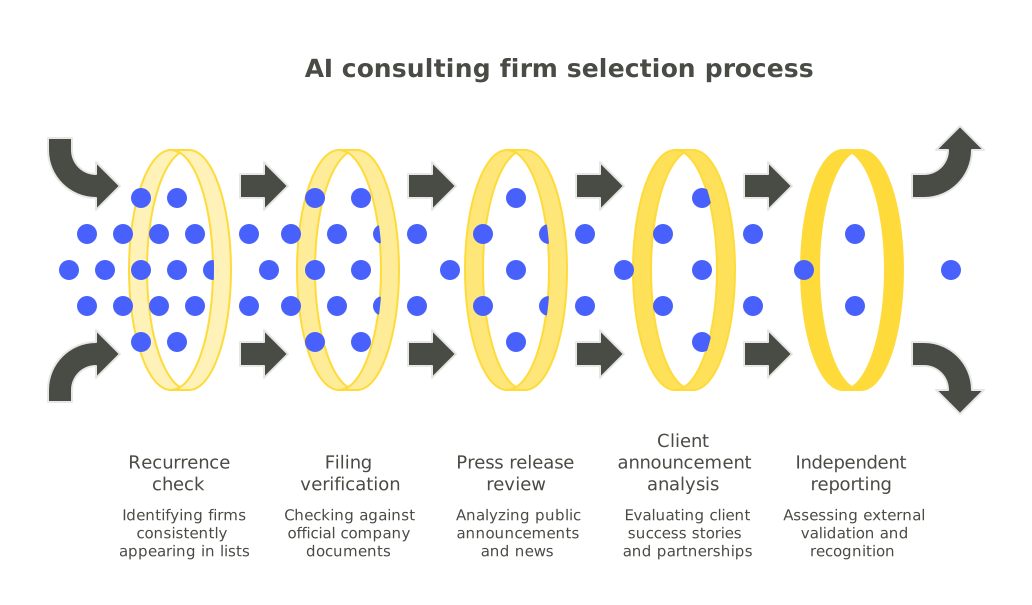
We started with the names that recur across the top-ranking “best AI consulting companies” lists. Then we threw most of those lists away. Many are published by AI vendors that rank themselves first, so we used them only to see which firms kept coming up.
Every candidate was then checked against its own filings, press releases, client announcements, and independent reporting. A firm made the list if it passed at least four of these five tests:
-
End-to-end delivery. The firm takes AI from strategy through production, and it has named or clearly described client work to prove it.
-
Something beyond staff time. It offers a proprietary platform, accelerator, or packaged engagement, such as a fixed-price discovery workshop.
-
Current Gen AI & agentic work. It shows client projects from 2025 to 2026, so the profile reflects what buyers need today.
-
Outside evidence. Its claims are backed by analyst recognition, financial disclosures, partner programs, or press coverage, not only by its own marketing.
-
A distinct place in the set. It adds something the other firms don’t (sector depth, a European delivery base, or a different engagement model), so the list covers the options a real buyer weighs.
We also filtered for relevance to the companies we work with most: mid-size and large enterprises in the US and Western Europe, especially the DACH region, that have moved past basic digitization and are now investing in applied AI, data management, and edge technologies.
Two groups, no ranking
The list is split into two groups: five large consultancies and five engineering-led specialists. We did not number the firms because comparing a $14 billion strategy house to a 300-person engineering firm would be more misleading than informative. The two groups answer different questions. A large consultancy is the natural pick when you need to transform an operating model across dozens of countries. A specialist is usually the better pick when you need a working system in production by the end of the next quarter.
Who didn't make the cut, and why
Several strong firms were left out.
Deloitte, EY, PwC, KPMG, and Bain all run credible AI practices, but their public evidence of shipped client systems was thinner than that of the five large firms we included, and we didn’t want ten Big Four profiles that read alike. Slalom, Quantiphi, and Tribe AI came close; we gave their spots to firms with a stronger European delivery footprint. The large Indian IT majors were excluded because their AI positioning centers on cost-efficient delivery, which overlaps with Capgemini and EPAM. Faculty, the UK specialist, would have qualified on its own, but Accenture now owns it.
Firms whose main evidence was self-published rankings or directory profiles were dropped, regardless of how often they appear in search results.
A note on ITRex
ITRex is on this list, and we wrote it. To keep that fair, we applied the same five tests to ourselves and described our practice the way we described everyone else’s: what we do, who leads it, what we’ve shipped, and where we’re not the right fit. Figures for all firms, ITRex included, are the companies’ own claims unless we note otherwise. All information is current as of October 2026.
Top AI consulting companies in 2026: our list
The table summarizes the key points. Detailed profiles follow, covering what each firm does, what it sells beyond consulting hours, who it has worked with, and where it fits best.
| AI consulting company | Group | Headquarters | Signature AI offer | Typical fit |
|---|---|---|---|---|
| Accenture | Large consultancy | Dublin, Ireland | AI Refinery, Faculty Frontier | Multi-year, multi-country AI transformation |
| McKinsey (QuantumBlack) | Large consultancy | New York, USA | QuantumBlack Labs, Kedro | Board-level AI strategy with a build arm |
| BCG X | Large consultancy | Boston, USA | Auto AI, Retail AI, Deep Customer Engagement AI | AI tied to operating-model redesign |
| IBM Consulting | Large consultancy | Armonk, USA | Enterprise Advantage, watsonx Orchestrate | Regulated enterprises on hybrid cloud |
| Capgemini | Large consultancy | Paris, France | Agentic intelligent operations (with WNS) | European enterprises automating business processes |
| Thoughtworks | Engineering-led specialist | Chicago, USA | AI/works, 3-3-3 delivery model | Legacy modernization with AI |
| EPAM | Engineering-led specialist | Newtown, USA | AI/Run, open-source DIAL | Large engineering programs, agentic customer service |
| Fractal | Engineering-led specialist | Mumbai, India / New York, USA | Cogentiq agentic platform | CPG, retail, and financial services analytics |
| Addepto | Engineering-led specialist | Warsaw, Poland | ContextClue, AI Discovery Workshop | Industrial and automotive data and AI |
| ITRex | Engineering-led specialist | Sacramento, USA | AI readiness assessment, PoCs, R&D | Mid-size and large firms moving AI from PoC to production |
Accenture
Large consultancy · Founded 1989 · Dublin, Ireland
-
What they do. Accenture runs AI programs from strategy through managed operations, and it buys capability fast. The firm committed $3 billion over three years to its Data & AI practice and has been adding specialists through acquisitions. The biggest recent one was the UK-based Faculty, which Accenture completed in March 2026. The deal brought in more than 400 AI professionals, and Faculty’s co-founder Marc Warner became Accenture’s CTO.
-
Beyond consulting hours. AI Refinery, built on the NVIDIA stack, supports custom agents and simulation. Faculty’s decision intelligence platform Frontier has now joined the portfolio.
-
Clients & results. Australian telecom Telstra formed a seven-year joint venture with Accenture, 60% owned by Accenture, and consolidated its data and AI vendors from 18 to two. Accenture’s advanced AI bookings reached $2.2 billion in Q1 FY26 (September–November 2025), nearly double the year before.
-
Best fit. Enterprises that need one accountable partner for a multi-year program across many countries and functions. If you need a single PoC delivered in eight weeks, you’re likely paying for capacity you won’t use.
McKinsey (QuantumBlack, AI by McKinsey)

Large consultancy · Founded 1926 (QuantumBlack in 2009) · New York, USA
-
What they do. McKinsey decides what a client should do with AI; QuantumBlack, its AI arm, builds the models, data pipelines, and agents. The firm’s surveys, including the State of AI report we cited above, shape a lot of boardroom thinking about AI.
-
Beyond consulting hours. QuantumBlack Labs has released several open-source tools, including Kedro, a framework for production-ready data science code. McKinsey’s internal Gen AI platform, Lilli, often serves as a reference case for clients.
-
Clients & results. ING worked with QuantumBlack to build and launch a customer-facing Gen AI chatbot in seven weeks. Deutsche Telekom built a capability engine with McKinsey to upskill 8,000 field and call-center agents.
-
Best fit. Leadership teams that need AI strategy tied tightly to business strategy and are prepared for premium rates. McKinsey is also among the AI consulting firms moving furthest toward outcome-based fees, which we cover in the market section below.
BCG X

Large consultancy · Founded 1963 (BCG X in 2023) · Boston, USA
-
What they do. BCG X is the tech build and design unit of Boston Consulting Group. BCG reported $14.4 billion in 2025 revenue, with AI- and tech-focused services accounting for over 40% of the total and AI services growing 25% year over year. The firm’s “10-20-70” rule puts 10% of effort into algorithms, 20% into technology and data, and 70% into people and processes.
-
Beyond consulting hours. BCG X deploys industry platforms such as Auto AI, Retail AI, and Deep Customer Engagement AI directly into client systems. According to BCG’s German press release, some of these offerings were developed in Central Europe.
-
Clients & results. BCG names IBM, Reckitt, and Foxconn as applied AI clients, though engagement details aren’t public.
-
Best fit. Companies whose AI problem is mostly an organizational one: redesigning workflows, roles, and incentives around new tools. The 10-20-70 split is a useful reminder that technology alone rarely moves the P&L.
IBM Consulting
Large consultancy · Founded 1911 · Armonk, USA
-
What they do. IBM pairs consulting with its own software, including watsonx and Red Hat OpenShift. That combination suits regulated buyers running hybrid cloud environments who want a vendor that can both advise and supply the platform.
-
Beyond consulting hours. IBM Enterprise Advantage is an asset-based consulting service that helps clients build and run their own hybrid AI platforms. IBM’s consulting agents can also direct SAP’s Joule agents.
-
Clients & results. Providence, one of the largest US health systems, deployed an HR agent built on watsonx Orchestrate inside its existing HR platform. After about eight months, managers spent 90% less time on hiring steps, and internal transfers moved 12 days faster on average. Pearson is building its internal AI platform on the Enterprise Advantage model.
-
Best fit. Large regulated organizations already invested in IBM or Red Hat. If you aren’t one of them, weigh how much of the proposed architecture depends on IBM’s own products.
Capgemini
Large consultancy · Founded 1967 · Paris, France
-
What they do. Capgemini Invent handles strategy, and the wider group handles engineering and operations from a strong European delivery base. The firm partners with Mistral AI, Microsoft, Google, AWS, and NVIDIA, which gives European buyers a credible sovereign-AI option.
-
Beyond consulting hours. Capgemini completed its acquisition of WNS in October 2025 in a deal valued at about $3.3 billion. The goal is to run agentic “intelligent operations” inside clients’ business processes, where AI agents take over steps in existing outsourced workflows.
-
Best fit. European enterprises that want to automate back-office processes and are open to an outsourcing model. If you plan to keep operations in house and only need help building your AI system, a smaller partner may be more cost-effective.
Thoughtworks

Engineering-led specialist · Founded 1993 · Chicago, USA
-
What they do. Thoughtworks is a software engineering consultancy, well known as the home of Martin Fowler, one of the authors of the Agile Manifesto. The company now pitches AI mainly as a way to modernize legacy systems and ship new products faster.
-
Beyond consulting hours. AI/works is an agentic development platform that reverse-engineers legacy code into specifications, then generates code, tests, and deployment pipelines. It works with AWS, Google Cloud, Azure, Databricks, and Snowflake. The platform underpins the firm’s 3-3-3 model: three days to a product concept, three weeks to a prototype, and three months to production.
-
Clients & results. Thoughtworks reports that a global agricultural manufacturer moved a mainframe warranty system to AWS in five months, 80% faster than planned.
-
Best fit. Enterprises whose AI ambitions are blocked by mainframes and aging codebases. The fixed-scope entry workshop is a low-risk way to test the team.
EPAM
Engineering-led specialist · Founded 1993 · Newtown, USA
-
What they do. EPAM is a large engineering services firm that has been repositioning around “AI-native” delivery since Balazs Fejes became CEO in September 2025. In July 2026, it announced a partnership with OpenAI to train and certify more than 5,000 forward-deployed engineers in the first year.
-
Beyond consulting hours. AI/Run combines blueprints, tools, and talent into a repeatable transformation method. DIAL, EPAM’s open-source orchestration platform, gives teams one governed API to many LLMs.
-
Clients & results. German telecom and internet provider 1&1 rebuilt customer service around agentic AI with EPAM and Microsoft. More than 20 AI agents now handle a share of weekly customer calls, and the first voice agents went live within six months of the project start.
-
Best fit. Large organizations, including in the DACH region, that need serious engineering capacity for multi-team AI programs. EPAM has told investors that procurement cycles for large AI deals are getting longer, so plan for a thorough evaluation.
Fractal
Engineering-led specialist · Founded 2000 · Mumbai, India, and New York, USA
-
What they do. Fractal is an AI and analytics specialist that listed on India’s stock exchanges in February 2026. Most of its revenue comes from clients outside India, with consumer goods and retail as its largest sectors.
-
Beyond consulting hours. Cogentiq, launched in 2025, is Fractal’s agentic AI platform with low-code tools, governance, and security built in. Fractal Alpha incubates standalone AI product businesses.
-
Clients & results. Fractal names Citi, Costco, Franklin Templeton, Mars, Mondelez, Nationwide, Nestlé, and Philips among its clients.
-
Best fit. Consumer goods, retail, and financial services companies that need demand forecasting, pricing, and customer analytics alongside Gen AI. Its revenue is concentrated in a small number of very large accounts, so ask how a mid-size client gets senior attention.
Addepto
Engineering-led specialist · Founded 2018 · Warsaw, Poland
-
What they do. Addepto is a Warsaw-based AI and data engineering boutique that US digital engineering firm KMS Technology acquired in December 2025. Its stated specialty is turning stalled proofs of concept into production services that fit the client’s existing stack (Databricks, Spark, Kubernetes).
-
Beyond consulting hours. Addepto sells a packaged AI Discovery Workshop and ContextClue, a knowledge platform that reads CAD, ERP, PLM, and technical documents for engineering teams. Directory listings put its rates at $50–99 per hour.
-
Clients & results. Addepto lists Rolls-Royce, Continental, Porsche, and ABB among its clients, which makes it a familiar name for industrial and automotive companies in the DACH region.
-
Best fit. Manufacturers that need a hands-on team for industrial data and document-heavy AI use cases. As with any recently acquired firm, ask how the integration with KMS affects team continuity.
ITRex
Engineering-led specialist · Founded 2009 · Sacramento, USA, with delivery teams in Europe
-
What we do. ITRex is a full-cycle AI consulting and engineering company. We assess whether a company’s data and IT infrastructure are ready for AI, prioritize use cases, help clients decide whether to buy, embed, or build AI, validate ideas through PoCs, and then develop, integrate, and support the system in production. Our work covers the full AI spectrum, from classical machine learning and computer vision to LLMs, agentic systems, and edge AI with locally deployed models.
-
Who leads the practice. Our AI consulting practice is led by Kirill Stashevsky, ITRex’s CTO and co-founder, with more than 20 years in software engineering and enterprise transformation, and Benjamin Aubron, our Gen AI Evangelist, who works hands-on with RAG systems, agentic architectures, and rapid prototyping. As Kirill puts it: “Every organization has a dozen AI ideas. A good AI consultant’s job is to be honest about which ones the data, the team, and the timeline can realistically support—before the budget is committed.”
-
Beyond consulting hours. We package our entry points so you can test us before committing a large budget. An outcome-led discovery workshop takes half a business day and costs $7,000–15,000. An AI readiness assessment takes 2–6 weeks and costs $15,000–60,000. A strategy engagement with a proof of concept runs 6–12 weeks and falls in the $40,000–120,000 range. Our in-house R&D team handles problems that have no off-the-shelf answer.
-
Clients & results. We built the NLP architecture and explainability engine behind WorkFusion’s AI agents for financial crime compliance. The platform is trusted by four of the five largest US and European banks, and the agents automate 60–70% of compliance-related manual work. For Dun & Bradstreet, we developed four custom machine learning models that added more than 100 million verified corporate contacts to its global intelligence platform. For Dimer Health, we engineered a HIPAA-compliant post-discharge care platform integrated with electronic medical records, which earned an NPS of 94. Other projects include a Gen AI sales training platform that cut ramp-up time from six months to two weeks and a computer vision platform that cut a US solar provider’s lead qualification time by up to 80%.
-
How we work. Before development begins, we tie every project to a measurable baseline and treat each proof of concept as a step closer to production. If rules-based automation or an off-the-shelf tool solves the problem, we’ll say so. ITRex is an OpenAI Select Partner with certified Claude engineers on the team, but we’ll recommend open source or a platform you already own if it makes sense. We identify cost and scope risks in writing before you sign, and the code and documentation we provide belong to your company. We are also ISO 27001 and 9001 certified.
-
Best fit. Mid-size and large companies in the US and Western Europe whose digital maturity is uneven: modern in some areas, held back by legacy systems in others. We also work with well-funded startups and enterprise R&D units that need a readiness assessment, product discovery, or a rapid prototype to shape their AI architecture early. If you need a global operating-model overhaul across dozens of countries or want to outsource entire business processes, a large consultancy from this list might serve you better.
That is the list. But before you start calling vendors, it’s important to understand the AI consulting market, as this influences what you should expect to pay and what you should ask for.
Where the AI consulting market stands in 2026
Demand for AI consulting has never been higher, and neither has buyer skepticism. Companies are spending more on outside AI help every quarter, yet they’re asking harder questions about what that money buys. Here’s what’s driving both trends and what it means for you if you’re about to hire an AI consulting firm.
Every large firm now sells a platform
Artificial intelligence has become a core revenue line for the biggest consultancies. Accenture’s advanced AI bookings nearly doubled year over year in Q1 FY26, and the company said it would stop reporting AI figures separately because AI is now part of almost all its work. At BCG, AI- and tech-focused services passed 40% of revenue in 2025.
The giants are also turning consulting hours into software. Accenture has AI Refinery, IBM has Enterprise Advantage, Thoughtworks has AI/works, EPAM has DIAL, and Deloitte, EY, and PwC all sell their own agent platforms. For buyers, that’s a mixed blessing. A platform can shorten delivery, but it also means the firm advising you on architecture has a product to sell you.
Supply is consolidating at the same time. Accenture bought Faculty, Capgemini bought WNS, and KMS Technology bought Addepto, all within six months. If you’re evaluating a specialist, it’s worth asking whether it’s still independent and who would own your account after an acquisition.
Businesses see value in outside help
The data supports bringing in a partner. According to MIT NANDA’s report The Gen AI Divide: State of AI in Business 2025, generative AI projects purchased or built with specialized vendors succeeded approximately 67% of the time, while internal builds only succeeded about one-third of the time. The lead author summarized the successful minority as follows: they focus on one pain point, execute well, and select partners carefully.
The McKinsey survey points the same way. The 6% of companies that get real EBIT impact from AI are nearly three times more likely than others to have fundamentally redesigned their workflows. That’s hard to do with an internal team that’s already running the business, and it’s where a good AI consulting partner adds the most value.
But skepticism is growing, too
The same buyers who see value in outside help are increasingly wary of who they hire. Several things feed that distrust.
-
Advisors who can’t build. Engineers on forums and anonymous workplace apps openly mock AI consultants who produce strategy decks but can’t debug a model, build a data pipeline, or connect a legacy system. A recruiter quoted by Fortune made the same point: traditional consultants can design AI strategies, but many can’t implement them.
-
Public failures. In 2025, Deloitte agreed to partially refund Australia’s Department of Employment and Workplace Relations for an A$440,000 review that contained fabricated references and a made-up court quote. The firm later disclosed that it produced parts of the report using a GPT-4o tool chain. For buyers in government and regulated industries, how a consultant checks AI-generated output is now a procurement question.
-
Agent washing. Gartner predicts that more than 40% of agentic AI projects will be canceled by the end of 2027 due to rising costs, unclear business value, or weak risk controls. It also estimates that only about 130 of the thousands of vendors selling “agentic AI” offer real agentic capabilities. Many of the rest have rebranded chatbots and RPA. Gartner’s analyst added that many use cases sold as agentic don’t need agents at all.
-
Grift at the low end. Small business forums are full of warnings about “AI agencies” selling vague automation packages with guaranteed results. The US Federal Trade Commission’s 2025 complaint against Air AI, whose customers allegedly lost up to $250,000 each, has made mid-market buyers even more cautious.
Does the price match the value?
AI consulting rates vary enormously, and the gap between them says a lot about what buyers will pay for.
Two patterns stand out. First, buyers accept premium rates for people who build: an AI consulting executive told Fortune that the $900 rate makes sense after two years of corporate AI experiments with little to show for them. Second, buyers increasingly resist paying senior-consultant rates for slide decks or for analysis that consultants now speed up with AI.
That pressure is reshaping pricing. About a quarter of McKinsey’s global fees now come from outcome-based arrangements, and EY leaders have floated a “service-as-software” model where clients pay for results instead of hours. Further down the market, fixed-price discovery workshops and short prototype sprints have become the standard way to start.
The challenges businesses face when hiring an AI consulting company
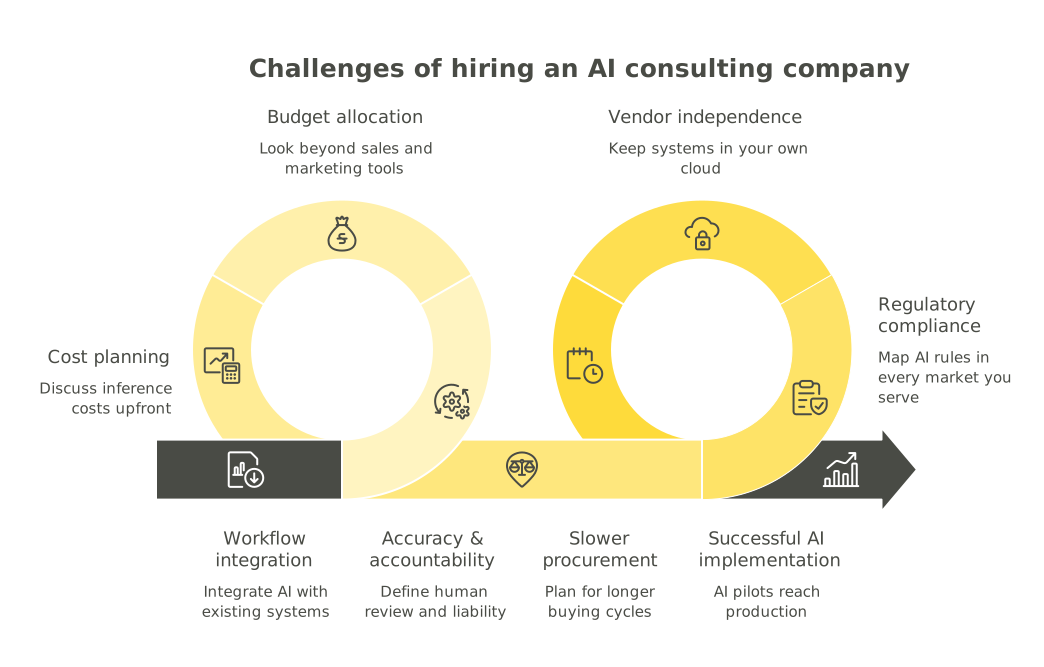
Based on market research and what we hear from clients, these are the problems that come up most often:
-
Pilots that never reach production. Integration with legacy data and workflows is the most common failure point. MIT traced most Gen AI failures to poor workflow integration, and it’s the main pitch of nearly every engineering-led firm on our list.
-
Budget in the wrong place. MIT found that more than half of Gen AI budgets go to sales and marketing tools, while the clearest returns come from back-office automation: document processing, invoice handling, support deflection, and internal knowledge search.
-
Running costs nobody planned for. An API-based LLM that’s cheap during a PoC can become expensive at full production volume, especially for agentic workloads that call models many times per task. Few consultants discuss inference costs, monitoring, and model updates before the contract is signed. In our article on why the token economy has a billing problem nobody budgeted for, we look at where these costs come from.
-
Accuracy & accountability. After the Deloitte case, buyers want to know where humans review AI output, how answers are checked, and who’s liable when the system gets it wrong.
-
A moving regulatory target. For European companies, the EU AI Act still applies, but the timeline has shifted. Under the Digital Omnibus agreement reached on May 7, 2026, obligations for stand-alone high-risk AI systems now start on December 2, 2027, and those for AI embedded in regulated products on August 2, 2028. Rules on prohibited practices and general-purpose AI models remain unchanged. If you’re not sure which regulations apply to your AI system, consider our EU AI Act consulting services. In the US, there’s still no comprehensive federal AI law, so companies deal with a patchwork of state rules. California’s transparency law for frontier AI developers took effect in January 2026, and Colorado replaced its original AI Act with a narrower law on automated decision-making that takes effect on January 1, 2027. A December 2025 executive order directs the Justice Department to challenge state AI laws, but it doesn’t override them on its own, and federal preemption bills have stalled in Congress. Until a court or Congress acts, state AI laws apply as written.
-
Vendor lock-in. When a consultant also sells a platform, their architecture advice may lean toward that platform. Buyers are increasingly demanding systems that run in their own cloud, on infrastructure they control.
-
Slower, stricter procurement. Large AI programs now face longer buying cycles and tougher evaluations, a trend EPAM has flagged to investors. Budget for that time in your plan.
Use these challenges as a checklist when you evaluate the firms on any list, including ours.
How to choose an AI consulting company: tips from the ITRex CTO
A shortlist of top AI consulting firms makes the search easier, but you still have to pick one. We asked Kirill Stashevsky, ITRex’s CTO and co-founder, how he would evaluate AI consulting companies if he were on the buyer’s side. Here’s his checklist.
-
Start with the business problem, not the vendor list. Before you contact anyone, write a one-page brief: what you want to change, how you measure it today, and what a good result would look like in numbers. Send it to your shortlist. Some firms will say they can’t help, some will propose a custom build, and some will point you to a tool you can configure for a fraction of the price. Their responses will narrow your list faster than any sales call.
-
Ask for production proof, measured over months. A demo shows what a system can do on a good day. Ask for case studies with results measured over 90 days or more, a reference client you can call six months after go-live, and a walkthrough of a project that didn’t go as planned. How a firm talks about its failures tells you more than its success stories.
-
Meet the people who’ll do the work. Ask who will be on your team, what their roles are, and how senior they are. You want AI engineers, data engineers, and a delivery lead in the room alongside the partner who closes the deal. If the firm can’t introduce them before you sign, treat that as a warning sign.
-
Start small & tie the first step to a single metric. A fixed-price discovery workshop, a readiness assessment, or a time-boxed PoC on your proprietary data lets you test the team before committing a large budget. Make sure the first engagement produces something concrete: a prioritized use-case list, a gap analysis, or a working prototype with documented assumptions.
-
Test their honesty. Ask which of your ideas they would not use AI for. A good consultant will name at least one process where rules-based automation, a better report, or an off-the-shelf tool would do the job for less. If every answer involves agents or a fine-tuned LLM, keep looking.
-
Check who owns what. Clarify upfront who owns the code, the models, the prompts, and the data pipelines when the project ends. Ask whether the system can run in your own cloud and what happens if you switch vendors. If the consultant also sells a platform, ask why it’s the right fit for you specifically.
-
Plan for life after launch. Get an estimate of monthly running costs at production volume, including inference, monitoring, and model updates. Find out how the firm will train your team, catch wrong or made-up answers before they reach users, and let you run the system without them.
A company that answers these questions clearly, using numbers and names, is worth further discussion. A company that responds with buzzwords probably isn’t.
The AI consulting market looks very different from just a few years ago. Several specialists have been acquired, and the biggest consultancies now sell software alongside advice. The question buyers ask has changed, too. Few executives still wonder whether AI works. They want to know whether a particular partner can get a working system into production at a cost they can justify to the board.
No single firm on this list is suitable for everyone. A global bank redesigning its operating model and a midsize manufacturer automating quality inspection require different partners, contracts, and budgets. Use the methodology, market context, and questions above to create your own shortlist, and insist on seeing a working system before committing to a larger project.
AI consulting companies: FAQs
-
Which companies offer AI consulting services?
AI consulting services are offered by large consultancies such as Accenture, McKinsey (QuantumBlack), BCG X, IBM Consulting, and Capgemini, and by engineering-led specialists such as Thoughtworks, EPAM, Fractal, Addepto, and ITRex. Large firms are usually the better fit for multi-country, operating-model transformations. Specialists tend to move faster and cost less for focused use cases, PoCs, and production builds.
-
What services do AI consulting companies offer?
Most AI consulting companies cover AI readiness assessments, use-case prioritization, AI strategy and roadmaps, product discovery, PoCs and prototypes, development and integration, MLOps and LLMOps, and AI governance. Engineering-led firms also build, deploy, and support the systems in production. Some, especially larger firms, add managed services or their own AI platforms.
-
How do AI consulting companies typically charge for projects?
AI consulting firms charge hourly, per fixed-scope engagement, or increasingly by outcome. Big Four partners bill around $400–600 an hour, while Central European boutiques charge about $50–99. Fixed-scope entry points are common: at ITRex, a discovery workshop costs $7,000–15,000, a readiness assessment $15,000–60,000, and a strategy engagement with a PoC $40,000–120,000. About a quarter of McKinsey’s fees are now tied to outcomes.
-
Which AI consulting companies specialize in generative AI projects?
All ten firms on our list run Gen AI and agentic AI projects, though their focus differs. McKinsey’s QuantumBlack built ING’s customer-facing Gen AI chatbot, EPAM deployed more than 20 AI agents for German telecom 1&1, and ITRex built a RAG-based Gen AI sales training platform that cut onboarding from six months to two weeks. Ask any firm which of its Gen AI systems are running in production today.
-
Are there AI consulting companies for small & mid-sized businesses?
Yes. Engineering-led specialists and boutiques are usually a better fit for mid-sized businesses than the large consultancies because they offer smaller entry points and lower rates. Look for a fixed-price discovery workshop or readiness assessment, a demo on your own data, and a clear price range before embarking on a full-scale project. Avoid any vendor that guarantees results or sells “AI for any business” without asking about your data first.